
Per-Seat Pricing Is Taxing Your Growth: The Boardroom Hallucination
An essay from 9horsemen's founder. For practical help running a business, see the blog. More thinking like this on our podcast, Why Your Software Sucks.
TL;DR:
The Trap: Silicon Valley hypes AI as a high-level corporate strategist, ignoring that small businesses are actually bleeding cash to bloated, everyday SaaS subscriptions.
The Extortion:“Per-seat” pricing is a manufactured penalty tax. Software companies hold your operations hostage, forcing massive subscription upgrades simply because you hired more staff.
The Reality: It costs a software company virtually nothing to route thirty vans instead of three, yet they treat basic digital plumbing as a tollbooth on your physical labour and margin.
The Fix: The economic maths has inverted. Renting off-the-shelf software is now the expensive legacy option; building a custom, unmetered micro-tool is the cheaper, lean alternative that permanently decouples your physical growth from digital licensing fees.
Per-seat pricing means paying for software by the number of people who use it, so the bill climbs every time you hire. While AI is sold as a boardroom strategist, this everyday pricing model is quietly eating small businesses’ margins.
Open LinkedIn right now, and you will see Silicon Valley aggressively selling you a digital executive board. Every week, a new enterprise vendor promises an artificial intelligence suite that will formulate your quarterly strategy, optimise global supply chains, or predict market shifts before they happen. The tech press eats it up, painting a picture where businesses run on pure algorithmic genius and high-level strategy.
But if you run an independent service business, your biggest technology headache isn’t a lack of artificial intelligence. It is the quiet, recurring extortion happening on your monthly credit card statement.
What is per-seat pricing?
It’s software priced per user: every person you add to the account adds to the bill, even though the software does nothing new.
Look at a real operation—a three-van residential pest control crew. The owner finally secures enough steady weekend contracts to justify hiring two summer apprentices. It should be a moment of absolute operational victory.
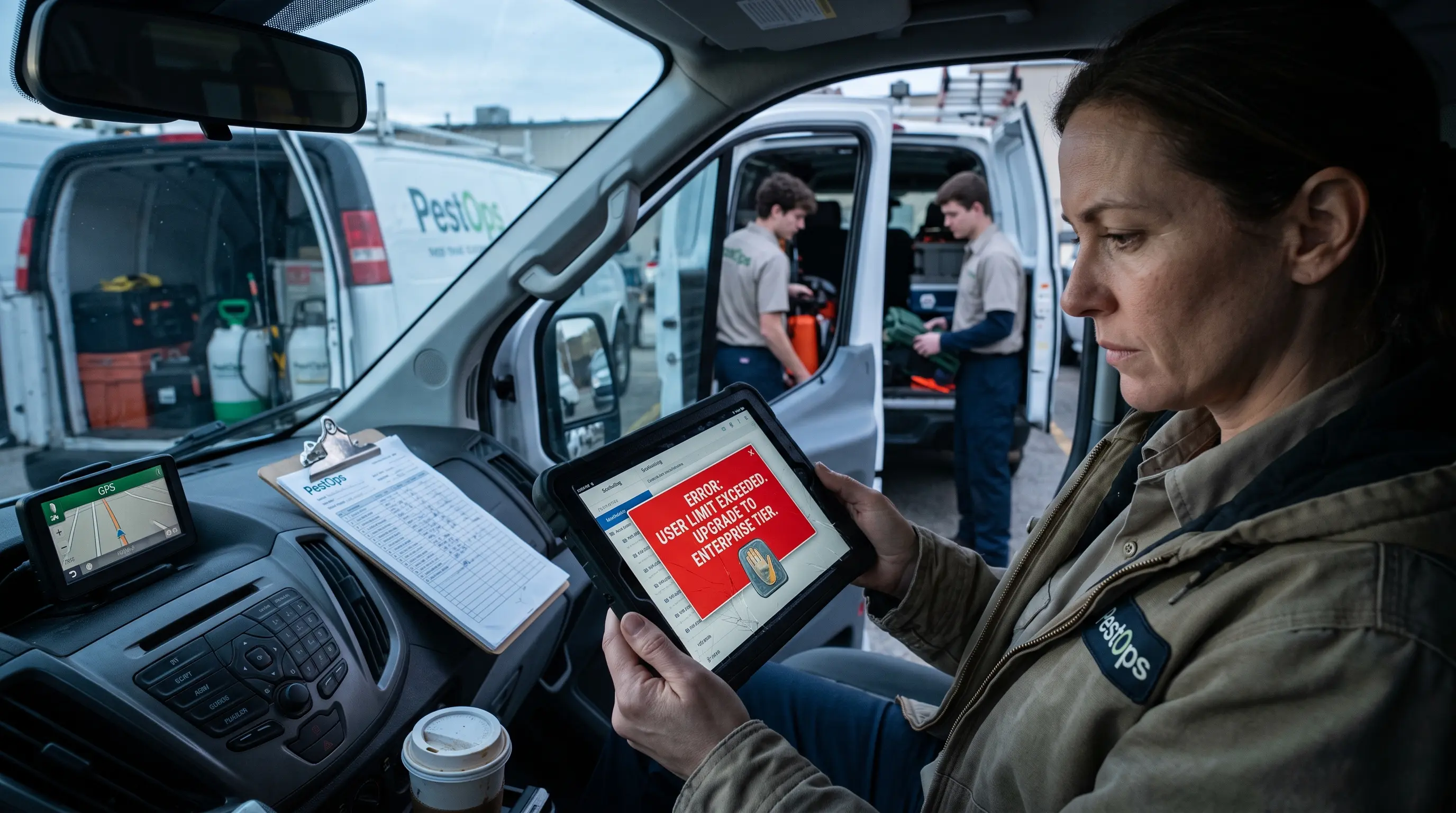
Instead, she sits in the driver’s seat of a Ford Transit at 6:00 AM, lukewarm coffee in the cupholder, trying to add those two new emails to the company’s daily route calendar. The moment she clicks “Add User,” a bright red pop-up blocks the screen: “You have exceeded your user limit. Upgrade to the Enterprise Tier.”
Overnight, her $600-a-month booking software leaps to $1,300. She isn’t unlocking better software, faster routing, or new capabilities. She is paying a penalty tax simply for putting more boots on the ground.
Why do software companies charge per user?
Because their investors need revenue that grows as you grow, and charging per person ties their income to your headcount.
Software companies love to preach about “partnerships,” but their pricing models are designed to act as a tollbooth on your physical labour. This is the “per-seat” trap.
Venture capital demands that software revenues scale aggressively. Big SaaS vendors can’t afford to just sell you a tool that works; they need a tool that takes a heavier rake the larger you grow. They’ve convinced small operators that basic digital plumbing—a calendar interface, a quote generator, a PDF exporter—is a living, breathing organism that requires eternal rent.
It is a complete myth. Once the code to route three pest control vans is written, it costs the software company fractions of a penny to route thirty. But they charge you an extra $8,400 a year for the privilege. They penalise you for hiring, ensuring that as your small business succeeds, their cut of your margin increases automatically.
How do you avoid per-seat pricing?
Choose tools priced per business rather than per person, or build small tools of your own now that AI has made that cheap.
Five years ago, escaping the per-seat licensing trap meant cutting a $40,000 cheque to an agency to build a custom application from scratch. Founders and operators gritted their teeth and paid the monthly SaaS ransom because there was no alternative.
That barrier has collapsed. The economic reality has inverted: renting bloated, off-the-shelf software with extractive per-user pricing is now the expensive, legacy approach. Building lightweight, owned micro-tools is the lean, pragmatic standard for ambitious entrepreneurs and modern SMEs.
Real operational leverage is not paying thousands each month for enterprise software packed with 90 features your team never touches. It is deploying a focused, unmetered tool that scales across ten team members or ten fleet vehicles for the exact same operating cost as one. True leverage restores your margins and decouples your business expansion from digital licensing tolls.
That’s the thinking behind Gallop, our first product. It builds a website, online booking and business app for a local service business, on one plan that costs the same whether you have one staff member or ten. It’s free to build, then one plan priced for your country (see pricing).
If Gallop is missing something your business needs, tell us at hello@9horsemen.com. We’d rather build it into Gallop for everyone than quote you for custom work. And if you’re building software of your own, Gallop isn’t that tool: I write about building it in the other essays and tell the long version in my story.
Related reading
- Is AI Automation Worth It? When Human Hands Are Cheaper Than GPUs: when paying a person is cheaper than running an AI model.
- The Death of the Enterprise Monolith: Why Micro-Apps Are the Future of Work: why one big platform loses to small tools built for the job.
- Is AI a Bubble? Data Centre Maths and the Race Against Time: the data centre costs that will push software prices up.