
Is AI a Bubble? Data Centre Maths and the Race Against Time
An essay from 9horsemen's founder. For practical help running a business, see the blog. More thinking like this on our podcast, Why Your Software Sucks.
TL;DR:
- Hyperscalers have spent $1.2 trillion on AI capex while generating only $277 billion in revenue.
- Because AI hardware depreciates in just 5–6 years, the industry faces an unyielding race against time, requiring up to $18.7 trillion in revenues by 2030 to justify planned expenditures—a target that enterprise ROI audits (such as Uber’s budget exhaustions) show is currently implausible.
Is AI a bubble? The numbers raise real doubts: the biggest tech companies have spent about $1.2 trillion on AI since 2024 and earned about $277 billion from it, on hardware that wears out in five or six years. Here’s the maths, the critics’ case, and what it means for a small business.
The technology sector is currently defined by an unprecedented economic paradox: historic capital expenditure paired with unproven monetisation. Across Silicon Valley, financial analysts, tech executives, and market commentators are questioning whether generative artificial intelligence represents a paradigm shift or the largest speculative bubble in modern economic history .
This comprehensive analysis breaks down the core arguments behind the “AI con” theory, evaluates the macro financial realities of data centre infrastructure, analyses the required return on investment (ROI) through 2030, and examines real-world enterprise adoption cases like Uber .
What Are the Core Arguments Behind the “AI Con” Theory?
The “AI con” theory posits that generative AI is being marketed as transformative “magic” to inflate corporate valuations, secure cheap capital, and obscure stagnant growth in core tech business lines . Rather than delivering autonomous general intelligence, critics argue the industry is selling expensive, subsidised, and unreliable software .
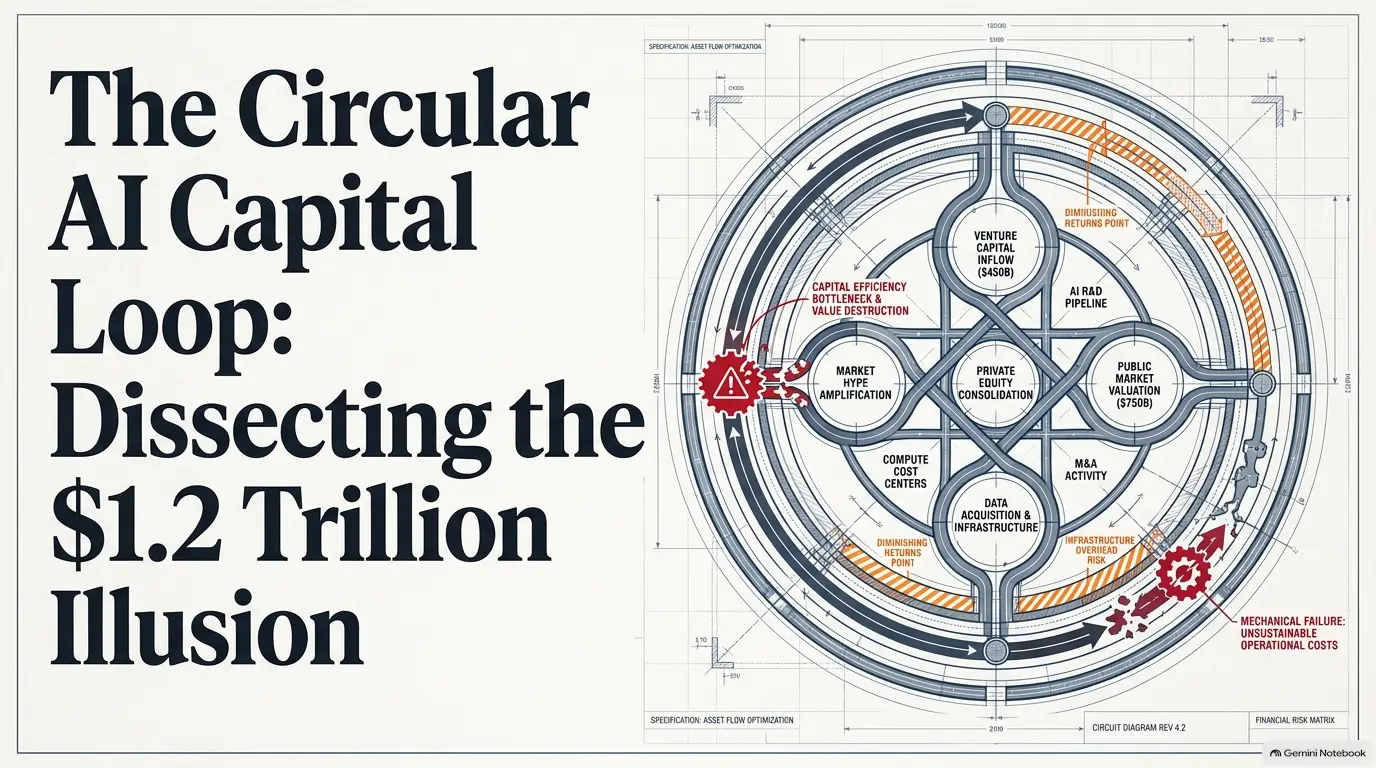
                         THE CIRCULAR AI CAPITAL LOOP

  ┌────────────────────────────────────────────────────────────────────────┐
  │                                                                        │
  │   Hyperscalers (Microsoft, Amazon, Google, Meta, Oracle, SpaceX)       │
  │   Spend ~$1.2 Trillion on Capex / Data Centers (2024–2026)             │
  │                                                                        │
  └───────┬────────────────────────────────────────────────────────┬───────┘
          │                                                        │
   Cloud Commitments                                         GPU Purchases
    & Investments                                           & Chip Revenues
          │                                                        │
          ▼                                                        ▼
  ┌───────────────┐                                        ┌───────────────┐
  │ Frontier Labs │  ═══ 70%+ of Global AI Revenues ═══►   │ Chip Makers   │
  │ OpenAI &      │                                        │ (e.g. Nvidia) │
  │ Anthropic     │ ◄═══ Subsidized Token Usage ($14k) ═══ │ $215.9B Sales │
  └───────────────┘                                        └───────────────┘
          │
          ▼
  Enterprise Users (e.g. Uber)
  Burn token budgets in 3 months without clear ROI
The loop originates at the top with the Hyperscalers (Microsoft, Amazon, Google, Meta, Oracle, and SpaceX). These tech giants sit on massive cash reserves from their legacy businesses and have committed ~$1.2 trillion in capital expenditures (from 2024–2026) to build out AI data centres and infrastructure. From the top box, the money flows downward into two primary channels:
- Left Arrow (Cloud Commitments & Investments): Hyperscalers inject cash and billions of dollars in cloud computing credits directly into the leading Frontier Labs (OpenAI and Anthropic).
- Right Arrow (GPU Purchases & Chip Revenues): Hyperscalers buy specialised AI GPUs and high-bandwidth memory directly from Chip Makers like Nvidia ($215.9 billion in sales).
This horizontal arrow connects the Frontier Labs directly to the Chip Makers / Hyperscalers.
- Concentrated Revenue: Roughly 70% of all global AI software revenues flow through just two companies: OpenAI and Anthropic.
- Recycled Capital: Because these two labs generate nearly all the industry’s software revenue, and because running AI models requires massive compute, almost every dollar they earn goes right back out the door to rent cloud servers from Microsoft, Amazon, or Google, and to buy Nvidia chips.
- The “Circular” Nature: Instead of revenue coming from thousands of independent, self-sustaining businesses, the money simply moves in a circle—Hyperscalers fund the Labs, the Labs pay for cloud compute and chips, and the money returns to the Hyperscalers and Nvidia.
Subsidised Token Usage ($14k) - What is a Token? A token is the basic unit LLMs use to measure text or code processing (roughly 3/4 of a word). Running inference to generate tokens requires enormous amounts of electricity and GPU hardware.
-
The $14k Subsidised Price: To encourage adoption, labs sell subscriptions at flat rates, such as $20 or $200 per month. However, industry analysis shows that a heavy power user on a $200/month subscription can consume up to $14,000 worth of actual compute tokens ($400 worth on a $20/month plan).
-
Operating at a Loss: The labs absorb this massive financial gap, selling compute for pennies on the dollar—which is why OpenAI lost $20.9 billion in a single year.
-
The Enterprise Reality Check: Because tokens are heavily subsidised, enterprise users get hooked on using AI for everything (“tokenmaxxing”). But when providers attempt to shift corporate users to true pay-per-token pricing, budgets collapse—such as Uber burning through its entire 2026 Claude Code budget in just three months\
Key Arguments of the AI Skeptic Framework
-
Overpromised Capabilities vs. Unreliable Software: Tech commentator Ed Zitron argues that generative AI is fundamentally a “half-ass arcery machine” sold under the guise of autonomous intelligence . Rather than replacing complex labour or curing diseases, LLMs operate probabilistically, frequently hallucinating and requiring human supervision .
-
Fundraising via Catastrophising: NYU Professor Scott Galloway and Ed Zitron both argue that big tech CEOs intentionally overstate both the utopian potential and existential threats of AI . Claiming a technology is “too powerful or dangerous” serves as a marketing ploy to justify sky-high earnings multiples and massive enterprise investments .
-
Subsidised Token Economics: End-users pay subscription fees (e.g., $20 to $200 per month) that cover only a fraction of the actual computing costs . Heavy power users can consume $400 to $14,000 worth of compute tokens per month, forcing frontier AI labs to run at staggering net losses .
-
The “Rotcom” / Growth Obscuration Thesis: Major tech monopolies have exhausted hyper-growth in their traditional markets (search, social media advertising, e-commerce) . Spending hundreds of billions on AI GPUs allows them to pitch an AI-driven future to Wall Street, boosting stock prices despite flat or slowing core innovations .
-
Socioeconomic Wealth Disparity: Galloway highlights that positive perception of AI is strongly correlated with personal wealth . High earners see AI as a portfolio engine, whereas middle-class consumers see inflated electricity bills and potential job disruption without equity upside .
What Is the Ed Zitron Interview About?
In a featured interview on The Diary Of A CEO with Steven Bartlett, tech writer and PR veteran Ed Zitron outlines a contrarian critique of the generative AI ecosystem.
╔═══════════════════════════════════════════════════════════════════════════╗
║                      ED ZITRON'S CORE THESES (DOAC)                       ║
╠═══════════════════════════════════════════════════════════════════════════╣
║  1. Financial Insolvency : OpenAI lost $20.9B; 70%+ of revenue flows      ║
║                            from just two unprofitable labs.               ║
║  2. Artificial Demand    : Enterprise adoption is driven by fear and      ║
║                            subsidised token pricing, not baseline ROI.    ║
║  3. Degrading Quality    : AI-assisted coding floods repos with buggy     ║
║                            code, increasing overall system outages.       ║
║  4. Infrastructure Strain: Data centres draw massive power, spiking local ║
║                            utility rates and utility demands.             ║
║  5. 2027 Collapse Horizon: Investor capital runs out as public listings   ║
║                            fail to materialise at promised valuations.    ║
╚═══════════════════════════════════════════════════════════════════════════╝
Core Points from the Zitron Interview
- Unprofitable Foundation: The market is propped up by circular financing . Roughly 70% of global AI software revenue flows through OpenAI and Anthropic—two labs that operate at severe losses and rely on cloud credits and direct cash injections from Microsoft, Amazon, and Google .
- OpenAI Losses: OpenAI recorded a net loss of $20.9 billion in a single year while spending tens of billions on model inference and training runs .
- Hardware & Power Requirements: Hyperscalers are building gigawatt-scale infrastructure . For example, the Stargate Abilene facility in Texas (developed with Oracle) is planned for 1.2 gigawatts (GW), housing 400,000 Nvidia GB200 GPUs across 998,000 square feet . This single data centre footprint consumes more power than the entire city of Bristol, UK (~700–800 MW) .
- Software Quality Deterioration: Contrary to productivity claims, industry data indicates that software outages and system downtime have increased due to AI-generated “code slop” . Engineers using LLM code completion often push buggy, unvetted logic into production .
- The 2027 Collapse Horizon: Zitron predicts that by 2027, the inability of AI labs to generate cash-flow-positive operations or list publicly at inflated valuations (e.g., $1 trillion targets) will trigger a liquidity crisis, leading to a broader tech depression.
Why is AI considered a bubble?
Because spending is running far ahead of revenue: about $1.2 trillion invested against about $277 billion earned, a gap of roughly $1 trillion.
The underlying economics of AI infrastructure are constrained by severe capital costs, energy draw, and rapid hardware depreciation .
+-------------------------------------------------------------------------+
|                  DATA CENTRE & GPU ECONOMICS BREAKDOWN                  |
+-------------------------------------------------------------------------+
| Capital Expenditure Allocation : 60% Equipment (GPUs) / 40% Buildings  |
| Useful Lifespan (Equipment)   : 5 to 6 Years (Straight-line write-down) |
| Useful Lifespan (Buildings)   : 39 Years                                |
| Stargate Abilene Power Draw   : 1.2 GW (300,000+ homes equivalent)     |
| Total Nvidia GPU Sales (FY)   : $215.9 Billion                           |
+-------------------------------------------------------------------------+
The $1 Trillion Spending Gap
According to financial analysis by economists Jared Bernstein and Ryan Cummings, six major hyperscalers—Google, Amazon, Microsoft, Meta, Oracle, and SpaceX—invested approximately $1.2 trillion in capital expenditures between 2024 and 2026, but generated only $277 billion in cumulative incremental AI revenues . This leaves an unprecedented financial deficit of roughly $1 trillion .
     HYPERSCALER AI CAPEX VS. REVENUE GAP (2024–2026)
     ================================================

  Spent Capex:   ██████████████████████████████████ $1,200 Billion
  AI Revenues:   ███████ $277 Billion
                 ----------------------------------
  Deficit Gap:   ░░░░░░░░░░░░░░░░░░░░░░░░░░░ $923 Billion (~$1 Trillion)
How long do AI chips last?
About five to six years before they’re written down to nothing, so the money spent on them has to be earned back fast.
Unlike traditional corporate infrastructure (e.g., fulfilment centres or real estate amortised over 39 years), AI capital investments consist heavily of silicon GPUs .
- Capex Composition: Hyperscale spending averages 60% equipment (chips/servers) and 40% physical buildings .
- 5–6 Year Depreciation Horizon: Nvidia GPUs and high-bandwidth memory setups have a useful shelf-life of only 5 to 6 years before they must be fully written down to zero value .
- Implication: Hyperscalers must earn back their multi-hundred-billion-dollar chip investments within a narrow 60-month window before the hardware becomes obsolete or worn out .
Why are AI companies racing against time?
AI companies are trapped in a race against time because hardware depreciation schedules demand immediate monetisation, while enterprise integration of new technologies historically takes decades .
                   THE DUAL TIMELINE MISMATCH
                   ==========================

  [ Hardware Depreciation Clock ] ──► 5–6 Year Expiration

  [ Technological Adoption Curve] ──► 10–30 Years (e.g. Factory Electrification)
- Short Hardware Lifespan vs. Slow Enterprise Adoption: Historical technological shifts—such as factory electrification or internet integration—took 10 to 30 years to yield macroeconomic productivity gains . However, AI labs do not have 30 years; their chip infrastructure depreciates in 5 years .
- Divergent Capex and Monetisation: Hyperscalers are escalating capex faster than end-users are expanding budgets . If revenue does not accelerate dramatically, investor patience will expire, depressing stock multiples and restricting access to debt markets .
- Circular Revenue Dependency: Much of the reported growth relies on circular deals where hyperscalers invest cash or cloud credits into AI startups, which immediately pay that capital back to buy cloud compute . Removing these circular flows reveals an even larger underlying revenue deficit .
How much does AI need to earn to pay off?
Up to $18.7 trillion over the next decade in the highest scenario, more than Google and Amazon earned together over their last ten years.
To justify existing and projected capital expenditures from 2024 through 2030, the financial returns required by hyperscalers reach astronomical figures .
Financial modelling using Discounted Cash Flow (DCF) analysis lays out the required revenue milestones across three scenarios :
- Low Scenario (Break-Even): Discounted at Weighted Average Cost of Capital (WACC) .
- Baseline Scenario (Standard Hurdle Rate): WACC plus a 10% net present value (NPV) hurdle .
- High Scenario (Matching Legacy Business Returns): Matching historical return rates above cost of capital .
Required Revenue Benchmarks
| Time Horizon | Planned / Expended Capex | Required Incremental AI Revenue (Break-Even) | Required Incremental AI Revenue (Baseline / High Return) |
|---|---|---|---|
| 2024–2026 (Expended) | ~$1.2 Trillion | $2.4 Trillion over 6 years | $3.8 Trillion over 6 years |
| 2027 (Next Year Target) | Annual Capex Spree | $520 Billion | $850 Billion (3x to 4.5x current revenue) |
| 2026–2030 (Planned) | $5.7 Trillion | $13.1 Trillion over 10 years | $18.7 Trillion over 10 years |
 REQUIRED 10-YEAR AI REVENUE vs. HISTORIC BENCHMARK
                       ==================================================

  Historical 10-Yr Revenues (Google + Amazon Combined):  ██████████ ~$13.1 Trillion
  Required 10-Yr AI Revenue (High Hurdle Scenario):      ██████████████ $18.7 Trillion
Contextualising the Maths
To reach the $13.1T – $18.7T revenue requirement over the next decade, the six major hyperscalers must build an entirely new AI business equal to or larger than the total revenue generated by Amazon and Google combined over their entire 30-year operational histories .
Is AI paying off for big companies?
Not clearly yet: Uber used up its whole 2026 budget for Claude Code in three months, without a clear link to more products shipped.
While AI vendors promise transformative productivity gains, corporate balance sheets tell a different story . The recent experience of Uber Technologies serves as a case study in enterprise “tokenmaxxing” .
╔═══════════════════════════════════════════════════════════════════════════╗
║                      UBER'S AI TOKENMAXXING METRICS                       ║
╠═══════════════════════════════════════════════════════════════════════════╣
║  • Annual Claude Code Budget Burn : 3 Months (Exhausted early)            ║
║  • Code Commits via AI            : 25% of total enterprise commits       ║
║  • Delivered Feature Pipeline     : 0% observable shift above the line    ║
║  • Executive Response             : Hiring slowdowns & spending audits    ║
╚═══════════════════════════════════════════════════════════════════════════╝
Key Insights from Uber Executive Statements
-
Budget Exhaustion: Uber CTO Praveen Neppalli Naga revealed that Uber completely blew through its annual 2026 budget for Anthropic’s Claude Code in just three months .
-
The “Head-Exploding” Audit: Uber COO Andrew Macdonald acknowledged that this budget collapse triggered an internal crisis regarding token consumption and headcount allocations .
-
The Missing ROI Link: Despite 25% of Uber’s code commits being generated via Claude Code, engineering leadership could not point to a single project moved off the cutting room floor or shipped to consumers as a direct result .
-
Unrealised Disruption: Uber CEO Dara Khosrowshahi noted that despite board fears that AI chatbots would disrupt online commerce, AI-driven commercial transactions have failed to take off . As a result, Uber is implementing hiring slowdowns to offset surging AI compute bills.
What does the AI bubble mean for small businesses?
Use AI only where it pays for itself, because a small business can’t subsidise tools the way big tech can.
The lesson from Uber’s three-month budget blowout is clear: deploying unconstrained AI models without strict operational metrics is not innovation—it is financial hemorrhage. When 25% of code commits come from expensive LLM tokens but not a single additional product ships to paying customers, the technology is functioning as an expensive parlor trick rather than business leverage.
While enterprise conglomerates burn venture capital on multi-gigawatt data centre speculation, ambitious entrepreneurs and scaling SMEs must operate in the real economy. In the real economy, software must prove its unit economics immediately.
That standard of capital discipline is how we build at 9horsemen: software has to pay for itself, so we use AI only where it earns its keep.
Our first product, Gallop, builds a website, online booking and business app for a local service business. AI reads the owner’s description; fixed, tested code builds the result, so the AI isn’t running every time a customer books. It’s free to build, then one plan priced for your country (see pricing).
If you’re building software of your own, I write more about the economics in the other essays and talk about it on the podcast Why Your Software Sucks.
Related reading
- Is AI Automation Worth It? When Human Hands Are Cheaper Than GPUs: when a person is cheaper than an AI model.
- Per-Seat Pricing Is Taxing Your Growth: The Boardroom Hallucination: how per-seat pricing taxes a growing business.
- How Much Does It Cost to Build an App? The Duct-Tape Defence: testing an idea with almost no money.